The Three R’s
Rigor, Respect, Responsibility
Rigor
Expand Advanced Placement opportunities and restore high academic expectations so students are challenged, prepared, and ready for college and careers.
Respect
Respect students, families, and teachers with honest grading, clear standards, and a school culture that values effort, achievement, and fairness.
Responsibility
Match authority with accountability by setting clear expectations for conduct, responsibility, and academic ownership throughout the district.
Equity Grading
CVUSD wasted and continues to waste hundreds of thousands of dollars on a failed Equity Grading system, a system designed to fix a problem that did not and does not exist, as shown in the district’s own graphic below (before and after grading distribution). Perhaps that is why they renamed it “Proportional Grading,” and more recently “Standards-Based Grading.”
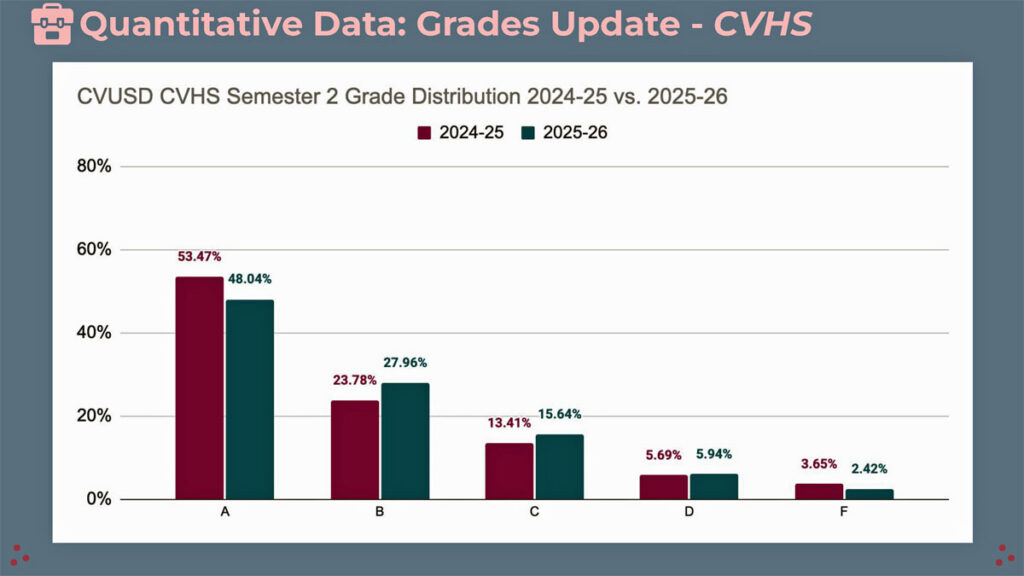
The primary justification for requiring Equity Grading was elimination of the steep, unfair, disproportional, dispiriting cliff that F grades create under traditional 0-100% grading scales (F = 0-59%). To do that, the district shifted downwards the grading scales and awarded students credit for submitting absolutely nothing. The district’s own data show that last year, before Equity Grading was implemented, F grades comprised less than 4% of all grades at CVHS. In other words, the justification applies to only a tiny fraction of the student body!
This year, after the district required all teachers to use Equity Grading, F grades fell by only 1.2%, a statistically insignificant change, indicating that equity grading had essentially no real world results among the student body. In fact, the only significant year-to-year change was a 5.4% shift from A grades to B and C grades.
I spoke anecdotally with teachers who experienced the same thing I did as a teacher: most failing students simply strive to work as little as necessary to earn passing credits with D- grades. Equity Grading allows these students to do even less and still pass their courses.
As for high achieving students, School Board Member Dolly Adams noted that her daughter, a teacher who uses Equity Grading, does not allow students who already achieved a high score like 95% retake a test because it would be a waste of a teacher’s time for a student to get an A+ instead of just an A. (https://youtu.be/qbQq3j7z6p8?t=8707) In other words, Equity Grading practices exclude the best students, which defines an inequitable grading system.
About 80% of the teachers surveyed two years ago did not want to use Equity Grading. In reality, full implementation is impossible and not even desired in the real world. For example, do you want the lesson plans, curricula, rubrics, and grading scales painstakingly and at great expense developed last year to apply to this year’s lessons? If you’re teaching Modern World History, do you want to exclude all of this past year’s interactions between Trump and the NATO leaders? Of course not!
Equity Grading requires that all teachers function robotically the same based on predetermined outcomes, which is not only impossible, it is undesirable and limiting to both students and teachers alike.
Follow this link to hear my comments on this issue at the January 21, 2026 school board meeting: https://youtu.be/qbQq3j7z6p8?t=7102
Advanced Placement (AP) Classes
For at least two years, CVUSD has denied students the opportunity to prepare themselves and position themselves better for higher education by limiting both their offerings and the numbers of seats available in Advanced Placement (AP) classes, as shown in the table below. Classes that are offered but are waitlisted are highlighted in yellow.
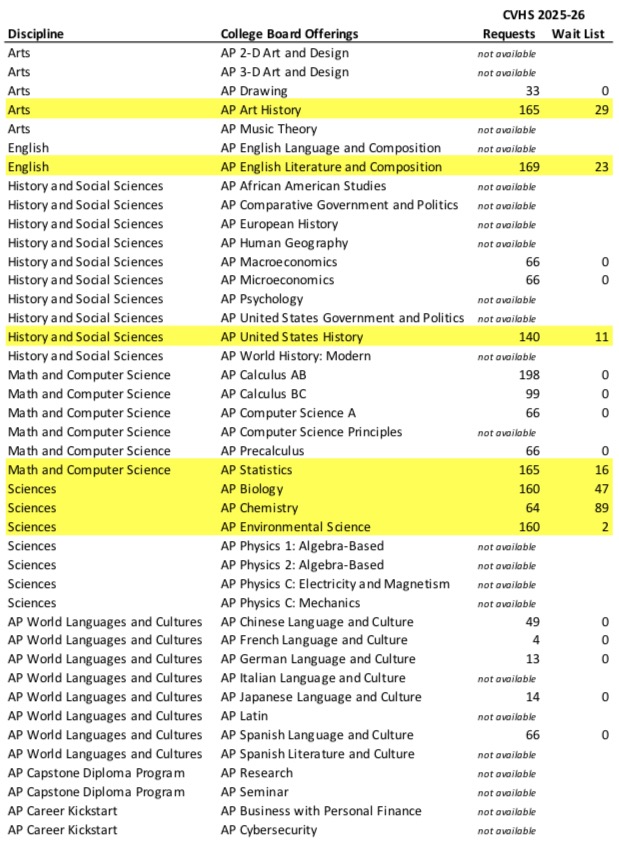
CVHS offers fewer than half of the available AP courses to our students, and limits the number of some of those classes as well. Instead, CVUSD could survey students and their families to determine the true demand for AP classes and then switch out regular core courses for AP versions of those classes.
Our superintendent bragged about our students’ high passing rates on the AP exams (scoring at least 3 out of 5 points), which should indicate that we have a group of students who want and crave a higher gradient of classes than provided in CVHS’s regular classrooms. Why are we putting caps on their choices, limiting their academic success?
True equity demands as many AP classes as students want, since they provide the least expensive, most easily accessible, and fairest availability of college credits students will ever have.
Priority on Achievement
On July 11, 2026, CVUSD promoted one of Canyon’s Assistant Principals to its new position of Assistant Director of Expanded Learning Opportunities Programs & Attendance Recovery, the primary duties of which will include “expanding access to learning opportunities beyond the school day, while strengthening attendance recovery efforts that help students stay engaged, connected, and on track for academic achievement.”
While it is important and laudable to work on convincing reluctant students to attend school, where is the similar commitment to the top academic achievers in the district? Who in the district is determining why parents enroll their kids in private schools like O’Dowd and Moreau, seek transfers elsewhere, or even home school their own kids? Why isn’t it a district priority to increase the number of Advanced Placement (AP) courses, to pay for all AP tests, or to pay for SATs since many universities are now reinstating them?
Here’s the announcement of the new Assistant Director position:
https://www.parentsquare.com/feeds/82939791
Lack of Transparency
The district prides itself on its transparency, but its practices do not match its proclamations. The Board and the district regularly tell citizens that they are always listening, collaborating, and making data-driven decisions. Yet, citizens regularly complain otherwise, noting that the board typically ignores data that they do not like.
If you have ever made public comments at school board meetings, read the minutes to see how your ideas were recorded. They probably weren’t. Instead, the minutes typically show nothing more than a person’s name and the topic that they talked about. Same with board discussions: the minimal minutes lack the character of the discussion. Worse, the district edits the YouTube videos of school board meetings and takes days and sometimes weeks before releasing them.
The district’s budget is almost 200 pages long. The budget is presented only by fund, which makes it practically impossible to understand. It lacks organization charts and position listings, so we do not even know how many staff are budgeted at any school site or in the district office. As a former California Society of Municipal Finance Officers (CSMFO) budget award reviewer, I would be hard pressed to award this budget even one point. Our budget tells us nothing useful. In fact, the only five-year table of revenues and expenses I could find was buried in a bond issuance’s Official Statement.
Look at the district’s most recent Annual Report (link below). It is available only online, not as a downloadable pdf. The Annual Report is 12-pages long and presents the district’s successes for the year including finances, inclusivity, belonging, Dual Language immersion, facilities improvement, culturally-responsive teaching, anti-hate language, health supports, equity grading, and minority staff hiring. What is missing? There is not one discussion of academic achievement, and isn’t that the primary purpose of schools?
Respect for Community
Ironically, our school district’s beloved mantra “All Means All” seems to exclude those who disagree with the district’s opinions. Throughout the winter and spring of 2026, the district solicited the community’s opinions on how to improve our schools through an online survey. You may recall seeing this announcement in January, 2026:
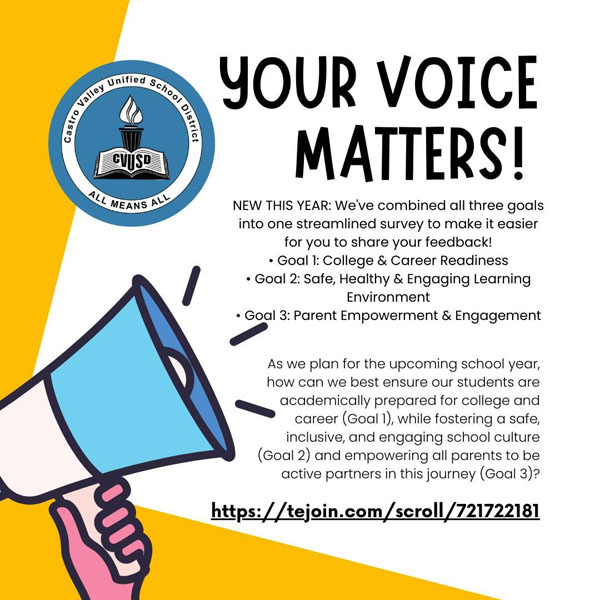
This survey was part of the Local Control Accountability Plan (LCAP) process. The community responded and proposed over 300 ideas and cast over 6,000 ratings on those ideas. The top five ideas are shown below. I am proud that the community voted my submissions as the #1 and #5 priorities.
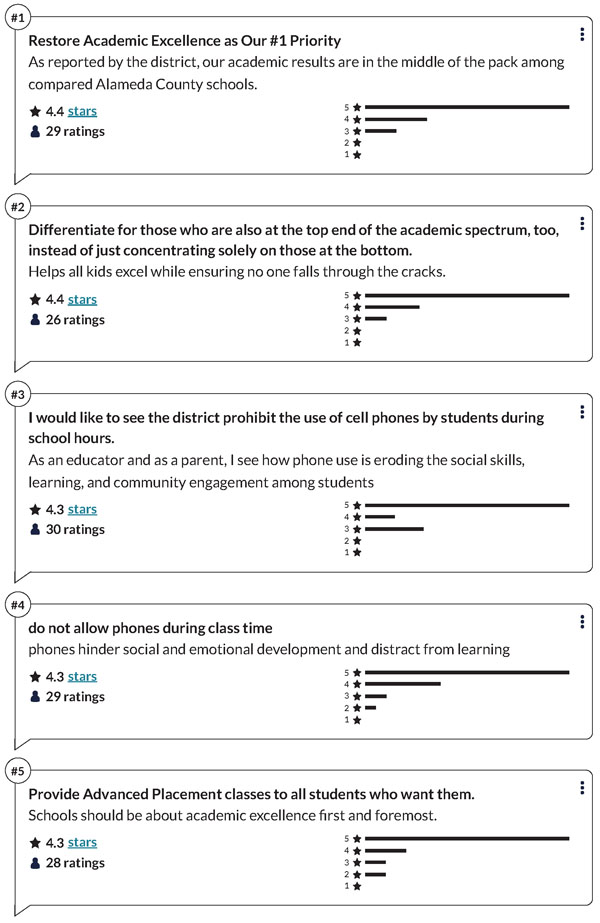
Sadly, the school board did not incorporate any of these top five ideas in their adoption of the LCAP plan at their June 24, 2026 meeting. View the school board meeting when I asked them why they were NOT listening to the community: https://youtu.be/myQrJAZc4Hk?t=1606
Even more concerning is that the LCAP incorporated $500,000 for Edgenuity and Cyber High online classes, programs with well-deserved reputations for cheating. Those same funds could have instead been used to hire five teachers or fix the broken pipe and roof pictured on the Measure B postcard.
Executive Salaries
In 2025, the school board hired our current school superintendent with a base salary of $360,000. She had no prior experience as a superintendent. In 2026, the school board increased her salary to $372,654—triple a seasoned teacher’s salary—and extended her contract another three years. Within three years, we will have made our superintendent a millionaire.
Back in 2015, our then-new superintendent had a base salary of only $256,000. That salary has increased about $10,000 per year since. Regular teachers could only dream of such raises. In June 2026, the Livermore Valley Joint Unified School District hired their new superintendent with a base salary of $329,000, and the Newark Unified School District hired their new superintendent with a base salary of only $260,000.
For comparison purposes, California’s Superior Court Judges earn $245-280,000. City managers who have far greater responsibility over a much larger population often earn less. In June, 2026, the Cities of Pinole and Brentwood hired their new city managers for $305,000 and $304,515, respectively. In July, 2026, affluent Sausalito hired their new city manager at an annual salary of only $275,000.
At their April 8, 2026 meeting, the school board updated their own $240 monthly compensation rate. California’s new compensation range for small school districts is $600-1,200 per month. The school board did not choose the $600 minimum rate or even the $900 middle rate; instead, they chose to compensate themselves at the highest allowable rate of $1,200 per month.
Castro Valley Democratic Club Endorsements
On August 6, 2026, the Castro Valley Democratic Club conducted endorsement interviews of the five Democratic candidates. While the quality of their video is not the best, I’ve boosted the volume and edited out the answers from candidates in other areas. The resulting video can be found here:
Provided below are my August 2, 2026 answers to the Castro Valley Democratic Club’s questionnaire required before the interviews. The questions cover a variety of important issues for the school district, and each answer is limited to 100 words!